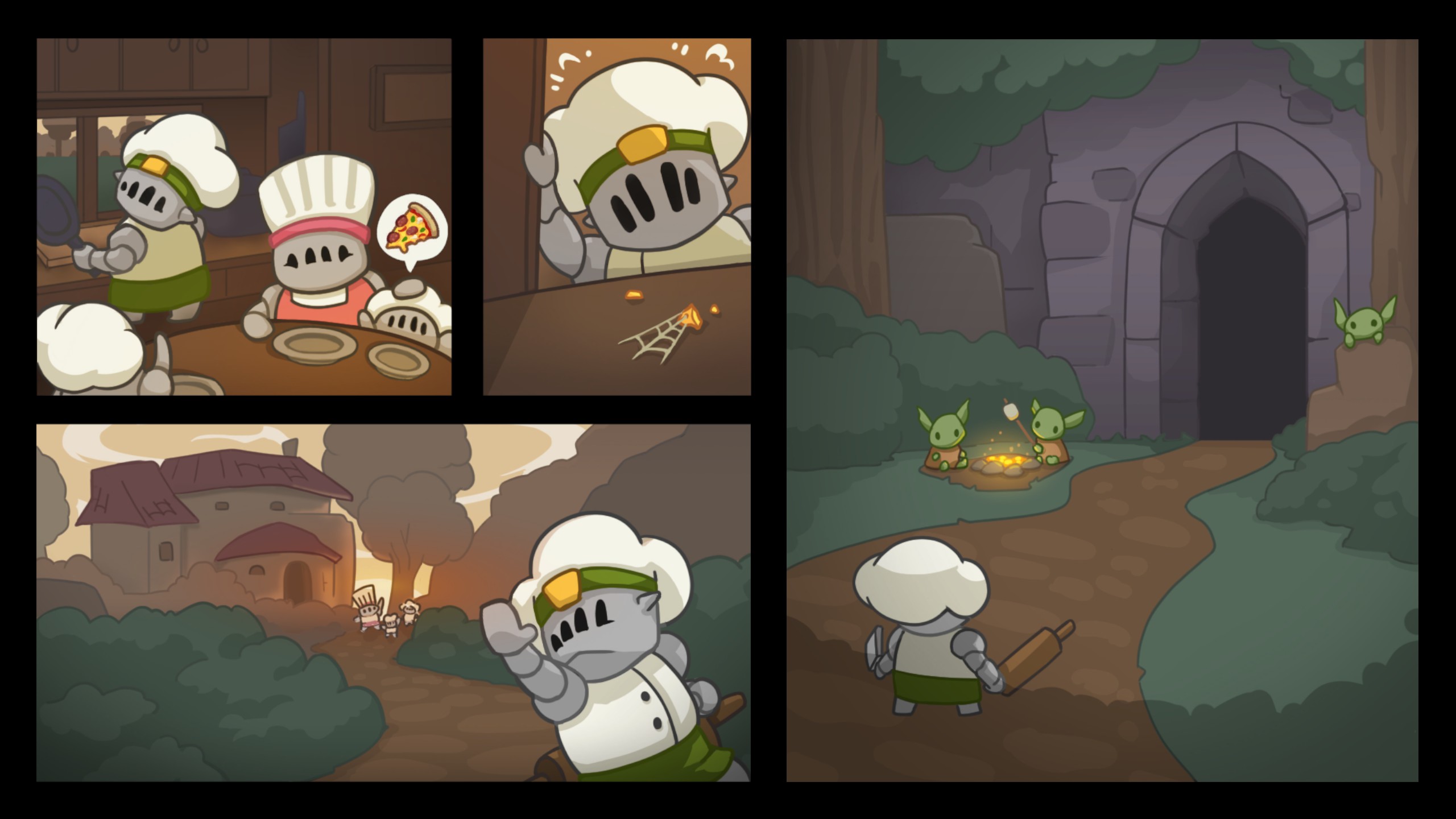
I very much enjoy incremental games, but one about killing monsters, cooking them, and then improving your parameters by selling dishes you make? It’s undoubtedly a terrific hook, and the gameplay and structure make good use of it. Chef Knight, unfortunately, is akin to most similar incremental games in that it’s only a few hours long and does absolutely nothing to extend its playtime, but it definitely accomplishes what it sets out to do, even if I really wish it had aimed a bit higher.
The game is very simple; there are four biomes to travel to, each with four floors. You simply destroy monsters on each floor until a meter fills up, at which point a door to the next floor opens and you travel to it. Floors one through three of each biome have a new monster in them, and all four floors have a new recipe to grab. The fourth floor has a recipe that makes use of all three monsters. Each time you kill a monster (initially just by throwing knives at it via your character’s attack cone), it drops cooking ingredients. Once you return to your base (either by running out of time, dying, or finishing the biome), you can now cook.
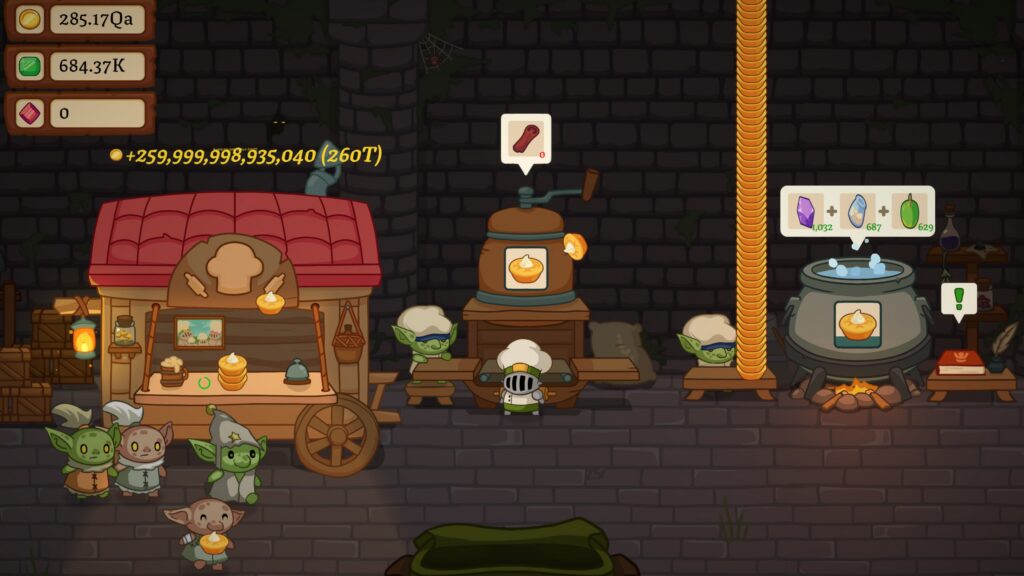
Cooking in Chef Knight is accomplished by approaching your cooking pot and putting your ingredients in. The game selects the recipe associated with the furthest level you’ve just reached in your last run, provided you have enough ingredients. Then you simply wait for the dish to finish cooking and carry it to your food cart, where goblins are lining up to purchase your wares. You also unlock a seasoning station that uses seasoning you find in bags in the biomes to triple the value of each dish. It’s an engaging little gameplay loop that I got a lot out of. Most biomes have a hazard associated with them, too, such as geysers of liquid or piranha plant enemies that snap at you, so there are dangers as well.
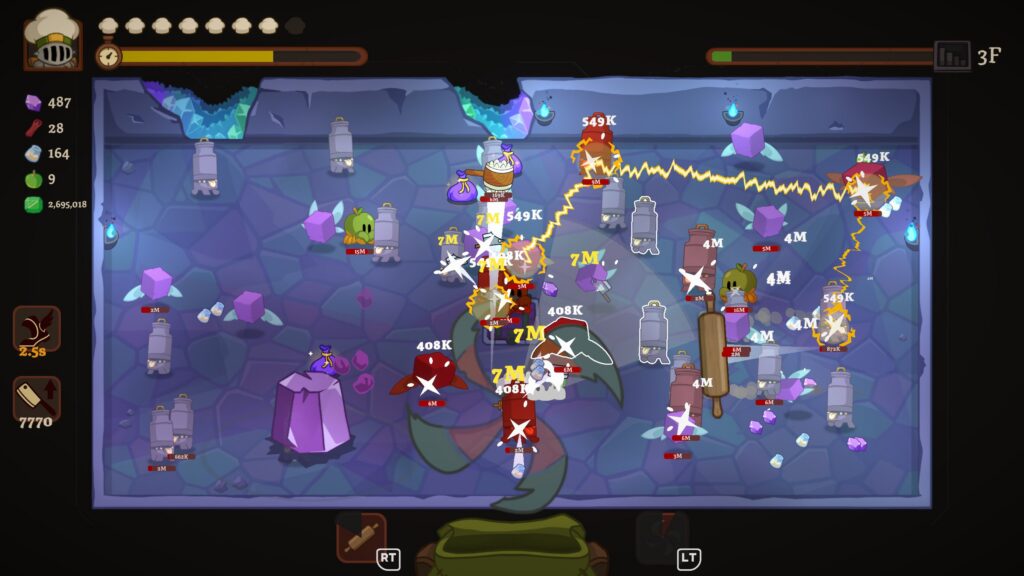
The money you make is then used to buy upgrades. These include your damage, how quickly you unlock the next floor, how many enemies spawn, and the effectiveness of your abilities, among many others. You get a hammer that randomly gets thrown, a rolling pin that you hurl at foes, and a spatula that you spin around rapidly to damage everything around you. These, too, can be upgraded. You’ll find chests with gems in them that are another form of currency you’ll use to upgrade items, plus completing quests grants you red gems that unlock even more. There’s a whole lot to unlock in the game, too, despite its brevity.
There are some balance issues here and there (sometimes the first floor of biomes can require too much grinding, only for later floors to be beatable on first try), but the game is decently polished. However, after a few hours, you’ll run out of things to do, and the game ends. I 100%’d the whole game in about four hours, and there’s no ascension mechanic that lets you start again with another layer of upgrades. Why every incremental game doesn’t include this when it’s such an easy idea that can massively increase a game’s longevity is beyond me, but there’s just nothing to do after these four hours.
Still, I enjoyed my time with it, I just wish the devs had been more ambitious, as the ideas on display here are great. All of these incremental games would be better off if they all had ascension mechanics, but you can do a whole lot worse for an evening of fighting monsters, cooking, and upgrading. The amount of content is standard for the price, and it looks pretty good, so I do recommend this one all the same.
Chef Knight: Too short and lacking any ascension, Chef Knight still excels at what it does with charming graphics and a novel premise. – Andrew Farrell
More culinary experiences:
PancitoMerge PC review — Breaking bread |