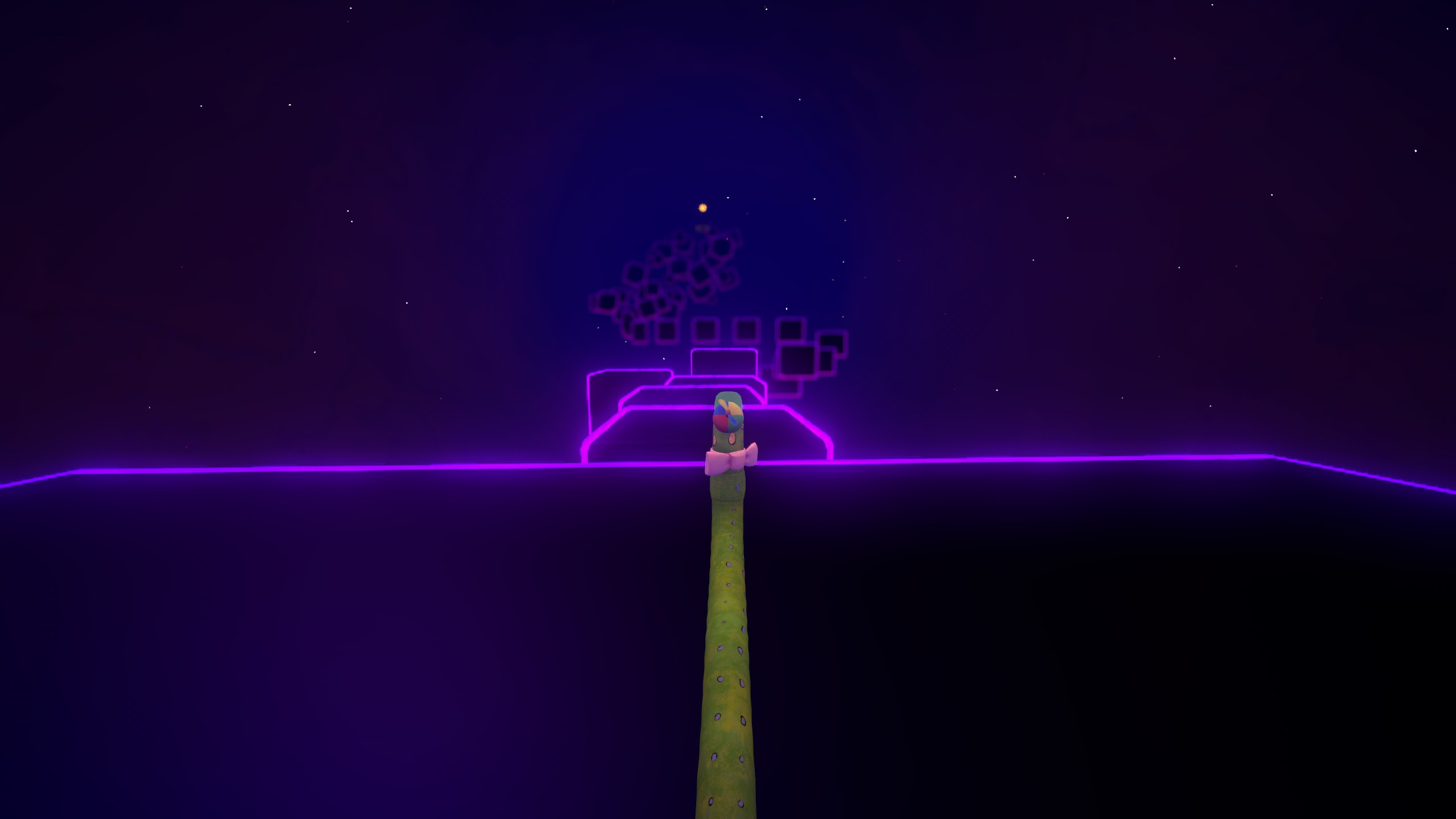
Surreal narrative games have a lot of leeway when it comes to their general gameplay. They can be about pretty much anything, but Skate Story is the only one I’ve seen that does this with skateboarding. The result is a trippy game that is almost always about the story and aesthetic, but also has enough well-implemented gameplay that it’s simply entertaining just to play. The result is a memorable experience with a pretty unique story and vibe.
Skate Story‘s premise is that the Glass Skater, a skater made of glass that lives in hell, has made a contract with The Devil to get his soul back. All he has to do is track down and eat seven moons and attend a banquet, and he’ll be home free. Despite how this sounds mostly like a game of Mad Libs come to life, there’s more world-building than you might expect, and the overall story ends up making a weird kind of sense in the end. It’s all delivered via text with no voice acting, though, even if there’s a pretty substantial amount of dialogue (plus every chapter ends with a little poem.)
The game has nine chapters and an epilogue and took me about six-and-a-half hours to get through. The initial chapter is fairly brief and takes about 30 minutes, while chapters two-through-six took 45 or 50 minutes each since they’re more open. The last few chapters are also more linear and on the shorter side, so the meat of the game is definitely in those middle sections. Skate Story varies between having you skate through multiple arches in linear spaces, open areas with some exploration, and multiple boss bottles, a couple of which are reasonably tough.

Despite the gameplay not being the focus here, Skate Story actually has a fairly unique skateboarding system. You press or hold a button to push off with your foot to keep your speed up (or double-tap for a stronger boost,) but most of the tricking comes down to the ollie button. Pressing this button in conjunction with the shoulder buttons results in different tricks, but you can even double-tap this button alongside holding left or right on the control stick to jump and do a mid-air spin. Double-tapping another button lets you switch stances, granted you switch versions of every trick, plus there’s a nollie modifier that does similarly. You can also execute manuals and grinds, although the grind is kind of spotty.
All of this is used in conjunction, since you’ll receive a smaller score increase for moves you’ve already used. This typically means that, once you need to build up your score, you’ll push forward and use your suite of tricks, switch stances, or start a nollie, and then finally execute a stomp, which immediately banks your score. This is mostly used to attack enemies and bosses (not that there are many enemies.) Bosses and the like have multi-sectioned health bars and you’ll need to at least do a few different tricks prior to stomping in order to deplete an entire segment.
Sometimes, you’ll need to trick and stomp to deplete the health of an arch before you can pass through it. At other times, three-to-five eyes will show up that you’ll need to trick over to shut them to unlock an arch. On occasion, you’ll need to perform specific types of tricks in succession to accomplish a goal. There’s a good variety here, even though most of it isn’t particularly challenging and doesn’t do much to actually require you to master the game’s trick system. Weirdly, you won’t really find any half-pipes and there aren’t any rotation-based tricks. Suffice to say, Skate Story does not play like Tony Hawk’s Pro Skater.

Boss battles typically require you to trick and then stomp within a spotlight of sorts. One of the bosses in particular is especially challenging since it has three rotating spotlights that need to be stomped within while chasing it. Even the final boss isn’t as demanding as this one, weirdly. Honestly, having to move at high speeds while finding the right time to stomp is kind of awkward, and I often didn’t enjoy having to do this. However, since there’s enough variety in between these, it’s all spaced out decently enough that you won’t feel like you’re constantly having to mess with this.
There are some open areas in chapters two-through-six that have some optional content here and there. You can explore to find stickers or items, plus there are gift shops that let you purchase new decks, wheels, and more. You can put stickers on your decks too, but these strangely can’t be removed. Any of the ones you don’t find out in the open areas need to be purchased with Soul, which you’ll get for beating bosses, destroying little objects with specific tricks, or by clearing Moonlit Spots, which require you to stomp out trick combos in designated areas.
My playtime in Skate Story was definitely extended a fair amount by doing all of the Moonlit Spots I found, as well as exploring. There are even some optional side quests, although I never found a reason to do this. Progression in the open areas is usually predicated on doing a favour for someone (one has you collecting letters in a few areas to help a writer out, another tasks you with finding and knocking over coloured traffic cones.) I enjoyed these, as they felt decently fleshed out, while also being quick enough that they never felt like padding.

Skate Story is strongly reminiscent of the works of Goichi Suda (of No More Heroes and Killer 7 fame), from the visuals to the sound design and story. Everything feels very artistic and the game goes to some pretty out-there places at times, but it still very much feels like its own game overall. Once you finish the story, however, there’s nothing else to do. I wish there was some sort of free skate mode or the ability to hunt for things you missed in the chapters, but it appears that all you can do is beat the game and that’s it. Still, there’s enough here to justify a purchase for anyone who likes avant-garde games, as well as skateboarding.
Skate Story: Skate Story introduces a fresh take on skateboarding, with plenty of action and layers of content to discover, which I wish would continue beyond the main story. – Andrew Farrell
Your next read: