As a rule, I typically don’t review rogue-lites. It’s not so much that I dislike them, but they have a tendency to slap incredibly obnoxious boss fights at the end that can make beating them a question of if more than when. But Absolum is a spiritual successor to Streets of Rage 4 (as it’s made by some of the same devs,) which I consider to be the best beat-em-up in existence. Well, until this game, anyway. This game, hands down, has the best beat-em-up gameplay I’ve ever seen, with lots of great features and truly impressive combat. But being a rogue-lite hurts it more than anything else. It’s a great game, but it would have been a lot better without needlessly putting itself in the rogue box.
You know the drill. You pick a character (of which there are two to start with,) then you begin a run mostly made up of beat-em-up sections where you walk from left to right, punching the crap out of everything that moves. The first great piece of evidence of why Absolum shouldn’t be a rogue-lite will become clear early on; levels are not at all randomly put together. The landscape and its pathways are pretty much the same every single time you play, with the difference being that the game’s three main islands all have more than one route you can traverse. Even the enemy encounters are often very similar, with only slight variations showing up. This means that it’s easy to get bored going through the same areas again and again with little difference.
That being said, there are some permutations and random events, so it’s not like you’ll be doing the exact same thing verbatim each time. But it’s close enough. The bosses are almost always in the same spots, and their fights are typically identical, no matter what (although this expectation did lead to a surprise or two eventually.) Due to all of this, I just don’t see why the game needed to be a rogue-lite, as this structure doesn’t really gel with it. You’ll find gems on your runs that you can use to purchase permanent upgrades, but these run out well before you’ll likely beat the game and even then, many of them aren’t particularly useful.

The important ones are the additional health, punish damage, and extra lives (you’ll end up getting two.) A lot of them impact the game’s hireable companions, mounts, and throwables, which typically aren’t things you’ll be constantly relying on to any degree. In the end, these upgrades aren’t going to be enough to tip you over the line if you’re struggling, and that’s because Absolum is a very skill-based game. Unlike Streets of Rage 4, which valued positioning above all else, this game lets you dodge, deflect, and counter enemy attacks with your own. It’s incredibly satisfying once the game clicks, as these defensive tools take what’s often a very cheap genre and improve it considerably.
Each character has a default attack string, skill, and specials that are unique to them. Galandra, the Drow swordfighter, has a default string that doesn’t use her sword at all, as only her skill and specials make use of it. Then there’s Karl, a Dwarf that mostly fights with his bare hands (and head) but uses a gun for his specials. These two are easily the best characters (with Karl taking the top spot for me.) Then you’ve got Cider, the fastest, weakest character, and Brome, a frog that has a magic staff. You unlock both of these as you play, and I didn’t use them much, as I found their general survivability to be a good deal lower than their two contemporaries.
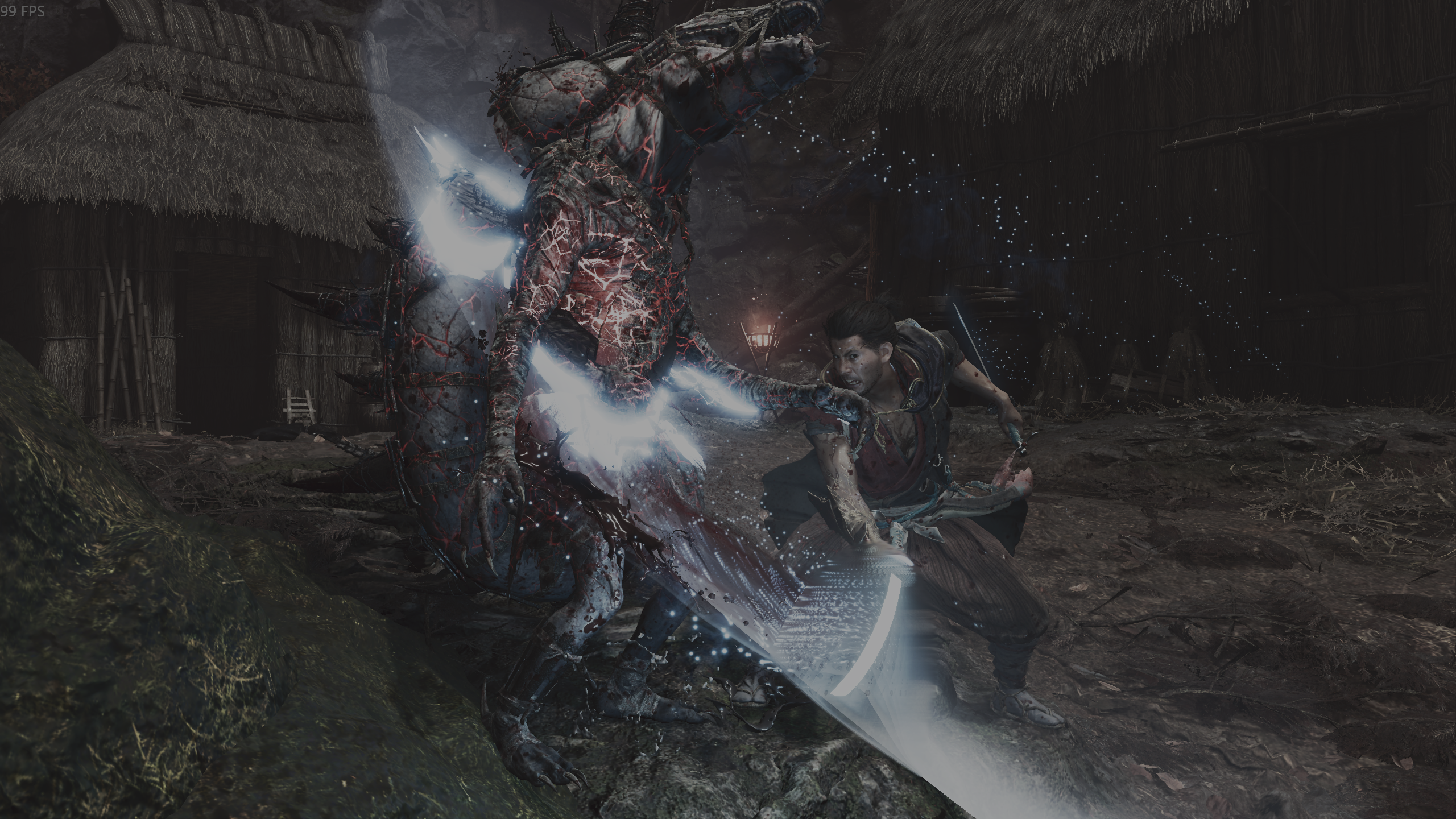
All characters can combo enemies, using the default string and its finisher, or with aerial and dash attacks that can send foes flying. Juggling foes is even more entertaining than in Streets of Rage 4, as each character has combos that can achieve this, but they can even continue hitting enemies that are grounded. Locking enemies in a combo chain will eventually overpressure them and send them flying to prevent you from comboing them infinitely. This is oftentimes as satisfying as it is humorous, especially when you’re knocking a boss from one side of the screen to the next.

One of your greatest assets is punishes, though. After deflecting, dodging, or countering an enemy attack with your character’s skill, enemies will take extra damage and become vulnerable afterwards. As such, weaving these into your character’s movements will make a huge difference. Absolum has a phenomenal rhythm to its combat like this. You’ll also make it to non-combat areas where you can heal, make purchases, and talk to NPCs, some of whom can be hired for the right price. Of course, you’ll frequently be rewarded with upgrades after combat encounters. These can add elemental effects to your moves or buff your character.
There are also a surprising number of quests that pop up, providing lore or granting various bonuses. Some of these unlock new pathways through the game world, for instance, so they’re well worth doing. Each character has their own personal questlines too, although figuring out what to do with these is easier said than done. I love the gameplay, graphics, and level design in Absolum. They’re all practically pitch-perfect, and the game is always a blast to play. But repetition does set in. I got pretty sick of the game’s first island, which takes 15 minutes and is mostly pretty easy, after a while.
The general encounters usually aren’t particularly challenging, but some enemies are so powerful that it can be difficult to move past them without taking severe damage. As you progress, elite enemies will start showing up that can make enemy encounters feel unfair depending on RNG. Once, I found myself in a small pathway with two elites and a mob that ended up tanking my entire run. You can choose to go to one of two different islands after completing the first one, and the bosses on these are absolutely no joke. Two of the more powerful bosses are particularly annoying to learn, considering that you’ll likely have to start the entire game over the first couple of times you get to them.

There are also mid-bosses that you’ll fight along the way, and these reward you with new moves that are annoyingly only unlocked this way. For instance, Galandra’s three-hit sword combo is only obtained in this manner. Locking the characters’ kits behind RNG is a particularly annoying choice that I really don’t like, as I’d prefer to be able to rely on them normally. One aspect I strongly disliked is that you have to take one specific route to fight an extra midboss, so you’ll end up going the same way in every single run just to get an extra move that your characters should be able to start runs with.
This last section itself is mostly the same every time you do it, and considering that you have to fight the exact same enemies through the exact same hallway every time you challenge one of the bosses, means that this part becomes a bit of a bore after you get there a few times. This boss is exceptionally tough, and getting to him only to lose time and again is incredibly annoying. I wish you could just practice him at your leisure instead of having to play through another 50 minutes of a run. Once you beat him, another boss is unlocked, but you can only fight them after beating the previous boss again.
This actual final boss has one of the most awful mechanics I’ve ever seen, too. Upon reaching it, it uses an area-of-effect attack that one-shots you. This means that you have to beat the previous boss fight while having at least one entire extra life, or you just lose the run automatically. I found this to be equal parts cruel and insulting, as it’s a transparent waste of the player’s time. It’s also a fairly challenging fight, but, much like the previous one, I often found that I couldn’t enjoy it, knowing that failure meant having to redo the entire game again, going back through the same exact pathways yet again.

Absolum is simply far too familiar run-after-run and would have been better experienced with a different focus. The permanent upgrades are underwhelming, and repeatedly restarting and doing the same things detracts from its excellent combat and level design. This is a great game that feels like it was made as a rogue-lite without a cause. While I do very much enjoy it and will continue to play it just for fun, I know I’d like it even more without having to deal with its annoyances.
Absolum: Absolum is one of the best beat-em-ups ever made, but only if you can look past its mostly unnecessary rogue-lite structure. – Andrew Farrell
Fancy another review?
Yooka-Replaylee PC review — Despite the fan rage, they’re still just a bat and a page |